Home Blog Page 25

High Endurance Pumps Support Sustainable Polymer Manufacturing

High Endurance Pumps Support Sustainable Polymer Manufacturing

The importance of so-called post-consumer trash as a raw material supply is growing. Since it frequently gets combined with tougher contaminants like sand, glass splinters, and metal foil residues, it normally needs to be sorted first. Either contact surfaces or extremely narrow spaces are used to seal throughout the pump pressure building process. At those locations, the foreign particles cause significant wear or seizing-up, which can reduce durability and result in unscheduled stoppages. New solutions increase the range of applications, increase robustness, and prolong service life. Additionally, the solutions work well with heavily loaded polymers.

The circular economy is subject to enormous cost pressure, while the basic raw materials are currently often cheaper. Beyond that the processing of post-consumer waste is relatively costly. This is primarily because it is difficult to filter out the impurities to a sufficiently clean quality. Consequently, the final purity of the recyclate has a massive influence on the achievable price.

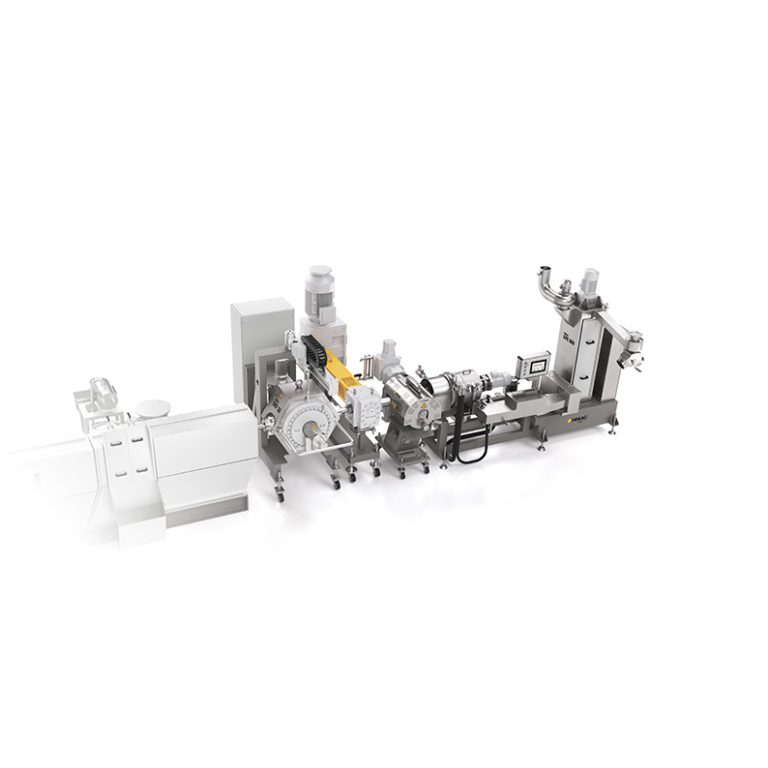
Extrusion system: Users can extend service life with timing gears. Photo Credit: Maag Pump Systems

High-quality recycling of recovered raw materials

There are basically two different recycling concepts that make up a circular economy. The first is pure filtration, or mechanical recycling of the polymer mix, whereby the foreign particles are removed from the existing polymer melt. The achievable purity is however limited in this process. It is therefore often unsuitable for direct contact with foodstuffs, and for applications imposing higher demands.

The second concept, chemical recycling, depolymerizes the polymer chains in the recycling process. This process either produces a low-viscosity intermediate product or breaks the raw material down directly into partially gaseous streams. Polymer generated from these recovered raw materials is of high quality, and can be used without restriction. The process sequence is more complex than mechanical recycling, however.

Extending service life, avoiding sudden stoppages

Both process concepts are the same initially. The post-consumer waste must first be shredded, and manually precleaned to remove coarse impurities. The more tolerant the downstream process chain, the leaner the precleaning can be implemented. Significant wear along the entire process chain is a familiar aspect of post-consumer waste recycling, and it is completely normal for many components to need replacement every year or two. The end of life of wearing parts is usually signaled by changing process parameters such as rotation speeds or temperatures. So their replacement can be planned and coordinated with other maintenance work. Alongside the general requirement to extend service life, it is extremely important to avoid sudden stoppages and unplanned maintenance interventions.

Filler agglomerates block flow channels

In highly filled mixes there are hardly any gaps between the fillers, and the interaction of the solids severely impedes the flow. Solids are repeatedly ground up in the flow, and the mix has limited flowability. Filler agglomerates behave similarly to impurities in recyclate, and can cause blockages. This is because the filler agglomerates tend to block flow channels – especially converging channels.

Higher concentrations can settle in converging flow channels, and the pressure pushes the polymer further out of the gaps between the filler particles, which further compacts the fillers, practically solidifying them. The pump is in effect blocked, usually without causing major damage. After cleaning – entailing a major disruption of the process – the pump can be run normally again.

More robust design

The latest-generation of pumps from Maag feature a design that no longer collects dirt in an annular channel between the bearing and shafts. This means the new design is inherently less susceptible to damage from solid impurities, oversized fillers or high filler concentrations. This attribute has proved its worth right from launch.

Traditional gear pumps that have not yet been optimized for such applications have some problem areas that are at high risk if the pumped material is contaminated. The worst impact is from medium-sized ductile metal parts about 0.2 mm in size or larger (depending on pump size) being drawn into the slide bearing. This then leads to seizing-up of the shaft in the bearing: crushing, and ultimately melting, of the particle, which consequently melts and tears open the bearing and the shafts. In the worst case, cold welding occurs; the pump comes to an abrupt stop, and can no longer be used. In the best case, the surface is broken up, merely impairing the operating limits to some extent. This does, however, mean that even minor faults can stop the pump running.

With the system for recycling post-consumer waste, users contribute to the circular economy. Photo Credit: Maag Pump Systems

Fewer teeth mean that the product is less compacted in the final meshing phase.

Gear pumps are generally optimized in terms of their bearings to work very reliably with a wide range of clean polymers. Because pure polymers in some instances have very extreme properties, good filling of the bearings is the main challenge in order to maintain a stable lubricating film. Recycling plants are always fed with a mixture, so the most extreme polymer properties such as melt breakage are not encountered. In particular, the mix contains various processing aids that have been added to counteract such phenomena. This opens up entirely new possibilities for the design of bearings. Instead of allowing open access to the bearing, the manufacturer has incorporated a local filtration at the bearing lubrication inlet. A special geometry ensures that the bearing is still supplied with melt, but the larger particles are no longer drawn into the bearing gap. Whatever still gets in can cause only limited, minor wear. This does result in the bearing geometry being washed out over time, though without causing serious unforeseeable damage.

The service life of the interior components is normally limited by general wear, and end of life is signaled by a gradual decrease in efficiency. This means that the replacement of wearing parts can be planned and carried out together with other maintenance work. As opposed to traditional filtration systems with filter surfaces, the gap does not clog up, and the teeth carry the particles into an area of the bearing where, almost like a backwash filter, the dirt is pushed back out of the gap.

Service life extended

In an application in which the pump had a service life of around two to three weeks, the manufacturer was able to increase it to between 18 and 24 months by incorporating the filtering bearings. Above all, abrupt severe failure due to bearing seizure is now completely eliminated. This represents a massive improvement in terms of reliability and robustness, makes production plannable, and is essential to a cost-effective operation.

When processing highly filled polymers, filtration reduces the concentration of fillers in the bearing. The reduction in filler significantly improves the convergent bearing flow. This bearing design enables a higher filler concentration in the conveyed polymer melt than would otherwise be possible.

Greatly reduce pre-cleaning

If users are forced to generate very high pres – sures at very high temperatures, the filtering bearings are no longer sufficient for stable operation with the impurities in the post-con – sumer waste. In such applications, a solution involving external lubrication of the bearings is deployed. A small amount of clean polymer (about 0.5 – 1 percent) that is compatible with the process and of sufficient viscosity is injected into the bearings. This ensures that the shaft is supported securely. Mixing the lubricant into the process slightly increases the downstream flow rate. At first glance, such an approach appears costly. But this process can, in some cases, substantially reduce the required pre – cleaning, and so is economical for that reason alone.

The special toothing to the right traps less polymer and leaves wider flow paths open. Photo Credit: Maag Pump Systems

Gear toothing made more robust

Another area in gear pumps that causes significant wear or blockages is the tooth meshing. When the second flank meshes, the remaining product stream must flow out via longer routes and through a narrower gap. Larger pieces of contaminant, in particular, can stick to the tooth root at this point, while the opposing tooth con – tinues to engage further into the tooth space. These larger pieces are then pressed together into the remaining gap between the tooth head and root. The more the trapped volume has to be reduced, the greater the risk of blockage. To prevent this effect, the manufacturer uses a special toothing design with fewer teeth for recycling applications. Fewer teeth not only mean that the product is less compacted in the final meshing phase; there is also much more room for the product to flow out in the first meshing phase while the opposing tooth is engaging in the tooth space. This additionally reduces the loading on the gears due to lower squeezing pressures.

Wear usually occurs on the contacting tooth flanks where the driving shaft drives the rotat – ing shaft. However, although the flank pressure increases due to the increased curvature of the optimized geometry, this new process means that far fewer particles are effectively trapped and ground between the flanks, and so the ser – vice life is extended.

Tooth flank wear significantly reduced

If the recyclate is so contaminated that the wear between the tooth flanks is unacceptable, users can install a timing gear between the reduction gear and the pump. This intermediate gear then drives both shafts simultaneously so that no torque transmission takes place in the pump, and the tooth flanks run practically contact-free. This significantly reduces tooth flank wear. The introduction of filtering bearings has extended service life from 2 or 3 months to between 18 and 24 months.

Changing to an optimized gear geometry also has the advantage that the teeth are thicker and more robust. This means that even larger particles can only cause dents and deformations in the teeth; they will not usually break.

Flexible modular system improves circular economy

Pumps that prevent accumulation of dirt in the annular channel between the shaft and bearing are suitable as a basic system. Moreover, the filtering bearings in conjunction with the optimized gear toothing on the shafts cope well with medium degrees of contamination and medium filler concentrations, provided the required pressure is not too high.

If contamination is higher, users can counteract the primary wear in the tooth meshing by installing a timing gear. This makes sense where users want to maximize service life, or where replacement part costs exceed the investment in the timing gear.

There is also an option to lubricate the bearings externally. A small additional extruder is integrated into the system to continuously feeds the clean polymer melt to the pump in order to lubricate the bearing. This is the only way to enable applications with higher pressures and thinner viscosities that would otherwise simply be inconceivable. With these measures, users can make much more out of post-consumer waste, and so contribute to the circular economy. Even heavily contaminated waste collected from nature can increasingly be included, which increases the incentive for collection for recycling.

https://maag.com/

#Maag #Modernplasticsindia #Pasticsnews #ModernPlasticsIndiaMagazine
#PrintPublication #Modernplasticssrilanka

Transforming plastic waste into value through efficient recycling innovations

Transforming plastic waste into value through efficient recycling innovations

In post-consumer recycling, a small footprint and high throughput are becoming more and more important factors. In response, EREMA is expanding the INTAREMA line and introducing the 2021 model at the K 2025 without a cascade. The growing number of food-grade applications is another trend. EREMA actively assists its clients in the authorization procedure and provides recycling solutions that ensure the highest quality levels. The company’s partnership with Lindner Washtech is one element that boosts added value in post-consumer recycling by guaranteeing a balanced end-to-end procedure.

The need for post-consumer recycled pellets to be utilized in delicate applications like food or cosmetics packaging, as well as secondary packaging, is growing due to legal regulations, particularly the EU Packaging and Packaging Waste Directive (PPWR), and the sustainability objectives of international businesses. To provide high output quantities with consistently good quality, these criteria impose more strain on recycling operations’ production capacity and process stability. To satisfy these requirements, EREMA provides dependable solutions.

(from the left): Clemens Kitzberger (EREMA), Patrick Cunningham (Strathroy Dairy), Michael Cunningham (Polymer Matters), Marcel Willberg (Lindner Washtech). Photo Credit: EREMA GmbH

The new INTAREMA 2021 TVEplus, now without cascade

Large plastics recycling plants need more than simply upscaling the individual components. The larger the size of the extruder screw, the greater the technological challenges. The start-up last summer of the largest INTAREMA system to date, with a throughput of over four tonnes per hour, confirms that EREMA offers reliable solutions for high throughputs. The next smaller size 2021 has now been further developed. “We have focused on the system and its individual components to ensure cost effectiveness and process reliability on this scale,” explains Markus Huber-Lindinger, Managing Director at EREMA. At the K show, EREMA will launch the INTAREMA  2021 TVEplus with a diameter of 2 metres for the preconditioning unit (PCU) and 212 millimetres for the extruder screw, which for the first time features a single end-to-end extrusion unit. With a throughput of up to 3.5 tonnes per hour and a footprint of just 15.1 x 3 metres, this recycling system is over two metres shorter than the previous cascade design, in which two extruders were connected by a melt pipe. The new design also reduces the melt temperature, lowers energy consumption and minimises maintenance requirements.

Based on TVEplus and EREMA PCU technology, the new 2021 produces even higher quality recycled pellets. Counter Current technology makes a significant contribution to this because it continuously feeds the extruder with preheated material that is 5 to 15 degrees Celsius warmer than with conventional cutter compactor systems. This is a technological advantage, especially for an extruder screw with a large diameter with correspondingly deep screw flights. The melt is processed more gently with less shearing and without additional particle size reduction. This makes it easier for impurities to be extracted by the melt filter, which is a key element of the new development. “It is thanks to our latest innovation in filtration that we have been able to implement the system on this scale. We will be demonstrating this innovation live at K 2025,” says Markus Huber-Lindinger. The system is also available with DuaFil Compact technology for even more efficient filtration.

The ReFresher control system is now networked with the PLC

Consistently high recycled pellet quality is essential for food and cosmetic grade applications. Recyclates for food packaging must meet the requirements of the European and American food safety authorities. EREMA has initiated numerous approval projects and, together with customers, has already received positive Non-Objection Letters (NOL) from a US authority for HDPE, PP and LD/LLDPE. Further approval proceedings are ongoing, especially in Europe. “A key driver of these projects is the new EU Packaging and Packaging Waste Regulation (PPWR), which stipulates a recyclate content of 10 per cent in sensitive packaging and 30 per cent in all packaging from 2030 onwards,” explains Clemens Kitzberger, Business Development Manager Post Consumer Recycling at the EREMA Group. “We are confident that we will obtain these approvals with our technologies. We use our expertise to provide our customers with the support they need during the proceedings.”

There are two decisive prerequisites needed for food-grade: an input stream consisting of at least 99 per cent food packaging, and technology that is able to clean and decontaminate the input material. A key technology here is the combination of INTAREMA TVEplus RegrindPro and the ReFresher, which reliably removes substances with low volatility, and as a result also removes odours. “What’s new is that the ReFresher control system is networked with our machine PLC,” says Markus Huber-Lindinger. “The new visualisation system combines the data from both systems to provide an intuitive and in-depth understanding of the entire process chain.” The combined data and trend analyses can also be accessed using the BluPort online platform.

EREMA and Lindner Washtech guarantee a balanced overall process

“One of the main success factors for consistent recyclate quality from post-consumer waste streams is the optimal coordination of each process step, from sorting and recycling to the final product,” says Clemens Kitzberger. Openness for knowledge transfer is needed here along the whole value chain.

That is why EREMA works together closely with strong partners, including within its own group of companies. The joint venture with Lindner has established a close partnership between EREMA and Lindner Washtech. While Lindner Washtech provides high-quality preparation of the input material with sorting, cold and hot washing, EREMA ensures effective cleaning and decontamination with its extrusion and filtration technology. Because the processes are well-coordinated, consistent recyclate quality is produced with optimised energy consumption. One specific application example is a project at Polymer Matters in Ireland, who have applied to the European Commission for food-grade approval. In this application, HDPE milk bottles from household recycling schemes are processed into rHDPE and used for the production of new milk bottles.

Visitors to this year’s K trade fair can gain an insight into the successful joint venture between EREMA and Lindner Washtech at the Edvanced Recycling Centre in the outdoor area.

Edvanced Recycling powered by EREMA

The current campaign Edvanced Recycling – EREMA Prime Solutions for Advanced Recycling sees EREMA present a wide range of advanced plastics recycling solutions. More than 40 years of experience combined with practical application expertise are the basis for EREMA systems consistently delivering high-quality recycled pellets to meet precise quality specifications, from food and cosmetic grade to more straightforward applications. Edvanced Recycling shows how EREMA is working together with its customers to sustainably increase the proportion of recycled materials used to make new plastic products.

www.erema-group.com

#Erema #Modernplasticsindia #Pasticsnews #ModernPlasticsIndiaMagazine
#PrintPublication #Modernplasticssrilanka

European Bioplastics Sets Up Headquarters in Brussels and Names New Secretary General

European Bioplastics Sets Up Headquarters in Brussels and Names New Secretary General

The European Bioplastics Association (EUBP), which advocates for the bioplastics sector in Europe, has formally moved its headquarters to Brussels. In addition to growing its network and boosting its visibility in the EU policy environment, the action reaffirms the organization’s dedication to lobbying and interaction with EU institutions.

The relocation is being accompanied by the announcement of European Bioplastics‘ new Secretary General, Lorenza Romanese, who offers a wealth of leadership experience in public relations and sustainability. In the organization’s upcoming stage of strategic development and increased integration with EU policy, Lorenza will serve as its leader.

“This relocation is a natural next step in our growth,” says Hasso von Pogrell, Managing Director of European Bioplastics e.V. “Being in Brussels places us at the heart of EU decision-making, allowing us to strengthen our advocacy efforts and foster deeper collaboration with stakeholders across the value chain.”

The move builds upon the successful establishment of EUBP’s Brussels office in June 2023 and is a strategic milestone reflecting the growing importance of bioplastics in Europe’s transition toward a circular economy. As the EU accelerates its efforts toward sustainable prosperity and competitiveness, European Bioplastics firmly believes that biobased, biodegradable, and compostable plastics are essential to achieving these goals. These innovative materials contribute to reducing dependence on fossil resources, advancing sustainable product design, and driving cross-sectoral innovation. With a stronger presence at the heart of EU policymaking, EUBP is well-positioned to support these strategic objectives and ensure that bioplastics are recognised as a key enabler of Europe’s green and circular transformation.

While the majority of EUBP’s core activities and advocacy work will now be based in Brussels, the Berlin office will remain open to support ongoing operations and maintain continuity of key functions including the annual European Bioplastics Conference, Seedling, Research and Innovation projects among others.

Commenting on the new chapter, Secretary General Lorenza Romanese stated: “I am honoured to join European Bioplastics as Secretary General. I look forward to collaborating closely with our members, stakeholders, and EU institutions to strengthen the voice of bioplastics, drive ambitious policies, and unlock the sector’s full potential for Europe’s sustainable future.

European Bioplastics advocates for a supportive policy and regulatory framework that enables favourbale market conditions for the bioplastics sector to thrive. The association serves as both a knowledge and business platform, bringing together key stakeholders to support the development, market introduction, and scale-up of sustainable bioplastic solutions across Europe.

www.european-bioplastics.org

#EuropeanBioplastics #Modernplasticsindia #Pasticsnews
#ModernPlasticsIndiaMagazine #PrintPublication #Modernplasticssrilanka

Lindner Powers Up K 2025 with Revolutionary Solutions Geared Toward Business Readiness

Lindner Powers Up K 2025 with Revolutionary Solutions Geared Toward Business Readiness

Utilizing its whole exhibition space at the K 2025, Lindner will be presenting innovative waste plastics processing methods and new products in Hall 9, Stand B17/19, and the outside area CE02. First-rate recycled quality, energy efficiency, maximum flexibility, intelligent process optimization across the whole value-added chain, and a first in mechanical recycling will all be highlighted.

The fourth-generation Micromat Lindner’s Micromat series is established globally as a reliable solution for shredding plastics. The fourth- generation Micromat has built on the proven strengths of Series 3, with added upgrades that improve both maintenance and productivity. A new drive concept is at the heart of the new series boasting efficiency above 97 % and a flexibly configurable blade system. Images Source: Lindner Recyclingtech

“Ready for the future of your business” is the mantra that guides the innovative technologies and developments that recycling pioneer Lindner is showcasing at the K 2025, including a world-first mechanical recycling system. The fourth-generation Micromat, whose intelligent technology raises the bar for material flexibility and energy efficiency, will also be on display to visitors. An outstanding illustration of the effects of comprehensive process optimization, from bale to pellet, of guaranteed recycle quality, throughput, and resource utilization is the joint venture between Lindner Washtech and EREMA.

Ready for energy-efficient versatility – the fourth-generation Micromat

For the new Micromat series, they have built on the proven strengths of Series 3, adding upgrades that improve both maintenance and productivity. The core of the new shredder series is the innovative drive concept that features a remarkable level of efficiency of above 97 %. Unlike a torque drive, the new concept operates without any rare earth elements and has an impressively long lifespan. Another highlight is the flexible, configurable blade system. This makes it possible to quickly replace pointed knives with step knives – which enables the shredder to flexibly adapt to different material requirements.

Ready for smart process control and guaranteed quality

Systematically and smartly optimising processes along the entire value-added chain – from shedding, sorting and washing to extrusion – is the key to achieving reliable quality standards and an efficient use of resources. These are only some of the results of the joint venture between Lindner Washtech and EREMA. “In the past few years, we have been working specifically on optimising process interfaces and look forward to presenting the results at the K 2025 together,” says Georg Krenn, Managing Director at Lindner Washtech. Topics include integrated plant engineering for a defined throughput, seamless and automated material flow regulation, smart performance monitoring and recyclate qualities for use in the cosmetics and food sectors.

Ready for a revolution in mechanical recycling

From post-consumer plastics to high-quality recyclate that can also be used in sensitive applications such as cosmetics and personal care – as well as being energy efficient and reliable? That was the key question at the start of the project. At K 2025, Lindner and a well-known partner will present a revolutionary world first in mechanical recycling. It is an innovative washing process that sets new standards in material purity, redefining the recyclate quality for the cosmetic and personal care sector. This technology also opens up access to other complex areas of application and the method will be presented for the first time at Lindner’s exhibition stand in Hall 9, Stand B17/19.

www.lindner.com

#lindner #Modernplasticsindia #Pasticsnews #ModernPlasticsIndiaMagazine
#PrintPublication #Modernplasticssrilanka

AZL Leads Joint Initiative to Expand High Value Composites in Space and Defence

AZL Leads Joint Initiative to Expand High Value Composites in Space and Defence

Leading lightweight technology engineering partner AZL Aachen GmbH is starting a new cross-industry project called “High Value Composite Applications – A Joint Market and Technology Study on Opportunities for Fiber-Reinforced Plastics in Space & Defence Applications.” The project unites multinational corporations to investigate and measure the potential of fiber-reinforced polymers (FRP) in the space and defense industries, two of the most innovative and dynamic sectors.

Project Key-Visual AZL Aachen GmbH

Shaping Emerging Markets with Composites

The demand for high-performance, lightweight, and modular components is accelerating rapidly in both sectors. With more than 50,000 satellites projected in orbit by 2035 and significant defence investments being implemented across Europe and beyond, the relevance of scalable composite-based structures has never been greater. This Joint Partner Project (JPP) aims to provide participants with a consolidated market and technology roadmap, combining deep technical insights with actionable strategic data.

A Proven Collaboration Format

The project will be executed as a Joint Partner Project – a pre-competitive, cost-shared initiative moderated and conducted by AZL. This format allows companies from across the value chain to jointly define focus topics, benefit from AZL’s expertise in market and technology analysis, and contribute their own perspectives throughout the process. Having coordinated over 15 such industry projects with more than 200 participating companies, AZL offers proven processes for delivering structured outcomes and fostering effective exchange between partners.

Kick-off and Participation

The project will begin with a Kick-off Meeting on July 15th, 2025. All participating companies will have the opportunity to introduce their organizations, share their expectations, and help define the specific scope of the study. This setting fosters transparency, engagement, and cross-industry insights. Companies interested in participating are invited to request the detailed project description and schedule an individual consultation with AZL’s industrial services team.

https://azl-aachen-gmbh.de/

#AZLAachen #Modernplasticsindia #Pasticsnews #ModernPlasticsIndiaMagazine
#PrintPublication #Modernplasticssrilanka

Visual 4 Control Update Delivers Greater Power Seamless Connectivity and Improved Interface

Visual 4 Control Update Delivers Greater Power Seamless Connectivity and Improved Interface

The newest robot control from Sepro Group connects plastics injection molders to a more user-friendly, powerful, and connectable control platform through a contemporary, lightweight user interface pendant. At the K 2025 trade show, the new Visual 4 control will be unveiled. In 2026, it will be accessible on all Sepro robots.

The most recent automation-control technology, created by Sepro especially for plastics injection molding, is shown in Visual 4. As part of this project, new hardware and software solutions with improved functionalities were developed. Users with prior Visual controls will just need a brief training session to get acquainted with the new platform because it is completely compatible with current Sepro systems and programming. The interface for part removal and downstream operation programming surrounding the injection molding machine is made simpler and easier to use with this new HMI.

The new Visual 4 control will be available in three variations with increasing capabilities for the full range of injection-molding applications:

  • Visual 4 is the basic configuration suits simple pick-and-place applications, providing control of up to 5 axes and 24 inputs/outputs (I/Os).
  • Visual 4 Plus supports more mold programs, with more I/Os, and allowing more connectivity to peripheral equipment (conveyors, sortation, etc.).
  • Visual 4 Pro is aimed at application-specific molding cells involving multiple robots, peripheral equipment and robots with special configurations.

Redesigned Operator-Interface Pendant

One of the first things one will notice about the new Visual 4 HMI is that the pendant is 25% lighter than its Visual 3 predecessor. The weight saving is the result, primarily, of moving the CPU board out of the pendant and into the main robot-control cabinet. This also results in greater data security, since critical components cannot be damaged if the pendant is dropped or otherwise compromised.

The Visual 4 digital screen on the pendant has an aspect ratio of 10:16 instead of 4:3 on the Visual 3 This more rectangular screen, positioned in portrait mode rather than landscape, has the effect of providing a larger display without any increase in the overall size of the pendant.

Like the screens on smartphones, tablets and other consumer electronics, the display on the Visual 4 pendant is a capacitive touchscreen, offering increased responsiveness and greater accuracy, while supporting multi-touch gestures. Graphic design is more modern, with a whiter background and less clutter.

In addition to the touchscreen, the Visual 4 pendant features 22 haptic shortcut buttons, providing quicker access to sub- menus and basic commands such as start/stop cycle, axial movement, etc. Buttons also eliminate the need for a joystick, allowing for more intuitive robot movement through multiple axes.

In addition to enhanced navigation and ergonomic features it also uses a powerful processor to control up to ten axes of motion, making it ideal for managing even complex molding cells, which can involve one or more than one IMM, and multiple robots in differing configurations, plus peripheral equipment that performs secondary functions like assembly, marking, inspection, packaging, and so on. It can store up to 1000 mold programs for easy recall.

Secure and Compliant

Security features on the new Visual 4 control include user-prole settings and authentication proles are used to determine which users or groups have access to specic features or applications. The new Visual 4 control is fully compliant with existing EUROMAP standards and future-ready to conform with new standards expected to be introduced in the next few years.

“Sepro Group began making robots in the late 1970s and introduced its first “CNC manipulator” in 1981,” says Dirk Schroeder, Sepro Germany Managing Director & Sepro Group Product Director. “Since the very beginning, we have been developing our own native control systems to suit the very special needs of our customers – plastics injection molders. So, we know what we are doing. This new Visual 4 control takes advantage of all we have learned over the years and now takes advantage of modern technology and know-how to deliver the kind of performance, flexibility and ease-of-use molders need in order to be successful today.”

https://www.sepro-group.com

#SeproRobots #Modernplasticsindia #Pasticsnews #ModernPlasticsIndiaMagazine
#PrintPublication #Modernplasticssrilanka

Next Generation S Line Robots Set New Standards in Performance and Payload

Next Generation S Line Robots Set New Standards in Performance and Payload

With a clamping power of up to 900 tons, Sepro Group has finished redesigning its high-end robots for use with plastic injection molding machines. The 3-axis S5 Line and 5-axis 5X Line, which have given molders the best automation performance for over ten years, will be replaced by the new S-Line robots, which make their premiere at the K2025 trade show in October.

Three new S-Line robot models have been designed to serve molding machines from 100 to 900 tons of clamping force, with three modular options:

  • a basic 3-axis servo-driven configuration
  • with additional servo wrist rotations for a total of 5 axes of CNC motion
  • or in special application-specific configurations such as a medical version adapted for cleanroom environments

The S Line robots are driven by the new Visual 4 control, making them suitable for the full range of injection-molding automation applications, including multi-machine, multi-robot manufacturing cells.

A highly rigid structure, including the use of cam follower bearings for linear motions, allows the robots to operate at 15% faster speeds for overall better cycle times than were possible with the previous-generation S5 and 5X Line robots. The Y-axis demolding stroke has been extended by to 200 mm (almost 8 inches), increasing the effective stroke length by 22 to 40%, depending on the size of the robot.

Maximum payload capacity (part plus end-of-arm tooling) has been increased by 20% in the standard models and 40% in heavy-load versions. All this while maintaining the precision and repeatability for which Sepro robots are well known.

The servo-driven wrist on the new S-Line robots is more compact than previous designs and all 5-axis versions can be equipped with the R3 rotation, which actually adds a 6th axis of motion for greater freedom of movement inside the mold space or outside the molding machine for secondary operations.

The aggressive, modern aesthetic design of the new robots includes multicolor LED lights on the end of the robot mobile. This feature, added in response to frequent customer requests, makes it easy for users to see the exact operational status of the robot even from across the shop floor.

Modular Approach

Beginning in 2021, with the introduction of updated Success Range general-purpose robots, Sepro began implementing a new, simpler modular approach to its products. In addition to delivering manufacturing economies, this approach makes it easy for the molder to consider all the options available and select the ideal robot for any application. Besides 3- and 5-axis robots, the new S-Line family now also includes special configurations – such as units designed for medical and clean-room applications– as options rather than as distinct product lines.

Modularity is extended further by the fact that the new S-Line robots adapt readily to complex cell applications where guarding, conveyors, insert-management, overmolding systems can be supplied as a packaged automation solution.

Sepro plans to continue reconfiguring and simplifying its entire product range and will redesign many of its large robots (for IMMs up to 5000 tons) for introduction in 2026.

https://www.sepro-group.com

#SeproRobots #Modernplasticsindia #Pasticsnews #ModernPlasticsIndiaMagazine
#PrintPublication #Modernplasticssrilanka

Brazil Maghreb Trade Mission Creates $500K Plastics Export Opportunities

0

Brazil Maghreb Trade Mission Creates $500K Plastics Export Opportunities

In the 31st edition of the Trade Mission, which focused on Africa and the Middle East and visited Algeria, Tunisia, and Morocco as part of the 2025 actions focused on global market expansion, Think Plastic Brazil, a portfolio of solutions for the plastic-converted products sector in the internationalization process for target markets, conducted through a partnership between ApexBrasil (Brazilian Trade and Investment Promotion Agency) and INP (Brazilian Plastic Institute), took place from May 26 to June 3.

As acknowledged in ApexBrasil’s diagnoses since 2023, the region’s potential is highlighted by its strategic geopolitical location between Europe, Africa, and the Middle East, as well as the characteristics of the countries, the industry undergoing change, and the pursuit of foreign direct investment. Market intelligence surveys are used to map technical barriers, distribution channels, logistics platforms, regulatory frameworks, and value chains.

“Qualified sectoral action, adapted to the regional particularities of international markets, is extremely important to us. This is an opportunity to open up the market, carried out with the preparation and support of specialized interlocutors, institutional partners and embassies to ensure the success of this relationship and future actions in the region,” says Carlos Moreira, Executive Director of INP and Think Plastic Brazil CPO.

With seminars, business rounds, technical visits and institutional presentations aimed at prospecting opportunities, commercial promotion, attracting investments and internationalization of production, the company participating in the action, Pincéis Atlas, a representative of the painting, finishing and civil construction materials segment, made an extremely positive assessment of the activities. It highlighted the visit to distribution channels and points of sale to understand how local markets work, commercial practices and competitive opportunities, recognizing the Mission as a well-executed and results-oriented action.

Think Plastic Brazil initially anticipated 3 business meetings and US$ 100 thousand dollars to be negotiated for the next 12 months, but left the region with the mark of 15 meetings held and an expectation of US$ 500 thousand dollars in business for the same period, meeting a concrete demand from the Brazilian business sector, for the opening of differentiated access channels to non-traditional markets, with growth potential.

https://lang.thinkplasticbrazil.com/

#ThinkPlasticBrazil #Modernplasticsindia #Pasticsnews #ModernPlasticsIndiaMagazine
#PrintPublication #Modernplasticssrilanka

Cosmo First Ltd Reinforces India’s Specialty Film Development via KARO IV Installation

Cosmo First Ltd Reinforces India’s Specialty Film Development via KARO IV Installation

Leading specialty film producer Cosmo First Ltd. stated that it has acquired the cutting-edge KARO IV laboratory stretching machine from Brückner Maschinenbau, placing India among the world’s leaders in the development of film technology. This calculated investment supports the nation’s Atmanirbhar Bharat program, which aims to increase India’s manufacturing capacity and lessen reliance on imports. Cosmo First’s standing among a select group of international film makers with cutting-edge R&D capabilities is further enhanced by this endeavor.

Through the reduction of development time and expenses for films intended for specialized uses, the KARO IV technology will greatly improve India’s capacity for producing specialist films. It will boost in-house development of proprietary film technologies and allow the domestic development of specialist film applications that are now imported, increasing self-reliance in high-performance flexible packaging. Before beginning production trials, the technology will enable Cosmo First to carry out comprehensive research and development, speeding up R&D timelines through affordable laboratory-scale testing.

“The KARO IV will transform how we approach film development in India,” said Mr. Kulbhushan Malik, Business Head, Cosmo Films, the flagship company of the Cosmo First group. “By enabling precise testing of films in both sequential and simultaneous stretching modes, we can now develop new film recipes and evaluate properties at a fraction of the cost and time previously required. This technology represents a significant leap forward in our ability to innovate. It opens doors for collaboration with academic institutions, supporting talent development in polymer science and reinforcing India’s position as a serious player in the global R&D landscape.”

The KARO IV features high stretching ratios from 1.01 x 1.01 up to 10 x 10, heating capability up to 400°C with up to 3 independent heating modules, an advanced EPC control panel with programmable test sequences, and state-of- the-art measurement equipment for stretching forces, displacement, and temperatures. The machine is equipped to handle a wide range of film types, including BOPP, BOPET, and BOPA, with consistent and accurate control over test film processes. The technology positions India to compete at the highest levels of specialty film innovation. Key competitive advantages include faster prototype-to-market cycles compared to traditional development methods, enhanced ability to develop eco-friendly, mono-material films aligned with circular economy goals, and the capability to partner with global brands for co-development of advanced film solutions.

The Indian packaging industry, historically, has lacked advanced lab-scale film stretching systems that could accurately simulate commercial production conditions, as most Indian manufacturers rely on full-scale production lines for R&D, making innovation costly and less agile. Additionally, the packaging industry is facing a regulatory and consumer pressure to shift from non-recyclable multi-material plastics to recyclable mono-material films. The installation will address significant gaps in India’s packaging innovation infrastructure.

Cosmo First increased its BOPP manufacturing capacity by almost 40% to 2,77,000 MT annually with the recent commissioning of a new BOPP line. By facilitating the quick creation of recyclable films and addressing India’s growing environmental concerns, the investment in KARO IV strengthens Cosmo First’s dedication to sustainable manufacturing. Through possible university partnerships, it facilitates the development of domestic knowledge in advanced polymer science and permits testing of novel barrier coatings, laminates, and formulations that satisfy recyclability targets.

www.cosmofirst.com

#CosmoFirst #Modernplasticsindia #Pasticsnews #ModernPlasticsIndiaMagazine
#PrintPublication #Modernplasticssrilanka

Aduro Welcomes David Weizenbach as Chief Operating Officer to Support Expansion

Aduro Welcomes David Weizenbach as Chief Operating Officer to Support Expansion

David Weizenbach, P.Eng., has been appointed Chief Operating Officer of Aduro Clean Technologies, a clean technology company that uses the power of chemistry to turn lower-value feedstocks, such as waste plastics, heavy bitumen, and renewable oils, into resources for the twenty-first century. His appointment takes effect on July 1st, 2025.

Mr. Weizenbach has over 30 years of experience in operations, engineering leadership, and industrial technology integration, including 25 years at NOVA Chemicals. He combines organizational expertise with technical competence. He has experience in a variety of heavy industrial settings with process automation, safety systems, capital project delivery, and operational governance. Mr. Weizenbach contributes extensive experience in risk-informed project planning, engineering systems, and operations leadership. His background in overseeing intricate technical settings and helping businesses navigate technological changes will help the Next Generation Process (“NGP”) pilot plant come online and set the groundwork for the company’s demonstration-scale facility and eventual commercial rollout.

For the past six months, Mr. Weizenbach has been working closely with them in a consulting capacity, supporting operational planning and scale-up strategy. His appointment reflects a natural transition into the leadership team at a pivotal moment as the Company expands its operations and moves toward pilot-scale execution and demonstration-readiness. His familiarity with Aduro’s culture, technical approach, and operational priorities ensures continuity and momentum as he takes on this leadership position.

“David is a highly experienced executive with a strong track record in process innovation, team leadership, and operational excellence,” said Ofer Vicus, Chief Executive Officer of Aduro. “He knows our people, our technologies, and our strategic direction — and his transition into this role comes at the right time as we accelerate commissioning of the NGP pilot plant and build the foundation for scaling to demonstration and commercial deployment. We’re pleased to welcome David to the team and are honored he’s chosen to embark on this journey with us.”

Before joining Aduro, Mr. Weizenbach operated an independent consulting practice focused on providing strategic technical guidance to industrial clients aiming to improve performance and implement emerging technologies. He advised a variety of organizations, including major manufacturers and specialized operators. His work included deploying advanced control systems, optimizing fired equipment and process units, and integrating performance data using both on-premise and cloud-based tools. He routinely supported transitions from legacy infrastructure to modern platforms, assisting in aligning operational strategies with broader organizational goals.

“I’ve spent more than three decades working in heavy industry, primarily with one of the world’s leading producers of ethylene and polyethylene, where I had the opportunity to lead outstanding teams across operations, engineering, automation, and emergency response,” said Mr. Weizenbach. “More recently, I’ve focused on helping organizations implement technology to drive safe, reliable, and efficient operations. I’m very excited to bring that same focus to Aduro as we scale our Hydrochemolytic Technology and establish the operational framework for commercial deployment.”

www.adurocleantech.com

#AduroCleanTech #Modernplasticsindia #Pasticsnews #ModernPlasticsIndiaMagazine
#PrintPublication #Modernplasticssrilanka